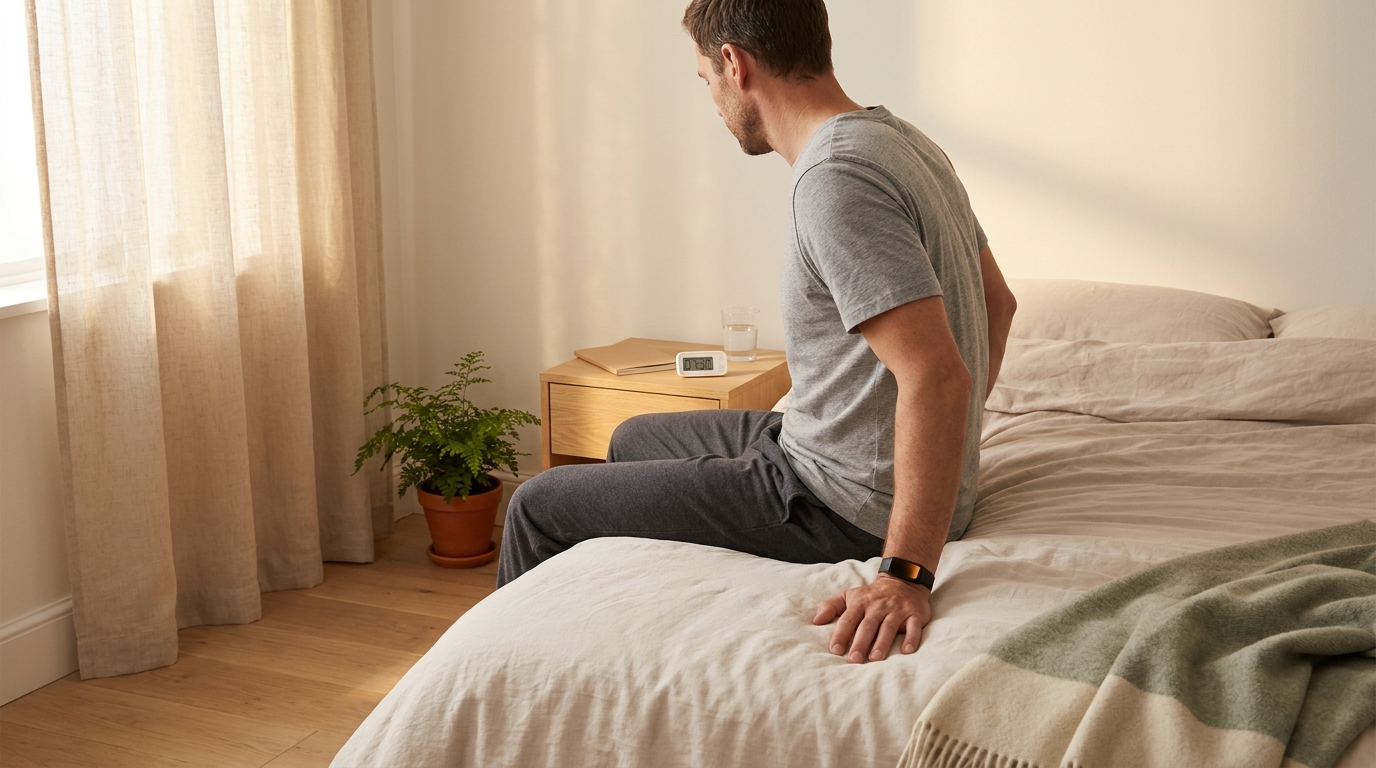
Every man who tracks his sleep eventually asks the same question: does an extra hour actually add years to his life, or is this just another wellness metric? The honest answer is that sleep is one of the most consistently studied modifiable factors in aging research, and the population-level evidence is genuinely strong, but it does not translate into a guarantee for any one person.
Table of Contents
- Why Sleep Keeps Showing Up in Longevity Research
- What the Population Studies Actually Measured
- Duration Matters, But So Does the Shape of the Curve
- The Proposed Mechanisms: Inflammation, Metabolism, and Cellular Repair
- Where the Evidence Is Strong and Where It Is Still Emerging
- Sleep in the Context of a Broader Longevity Strategy
- What This Means for Someone Reading Their Own Sleep Data
- FAQ
Why Sleep Keeps Showing Up in Longevity Research
Sleep sits alongside diet and exercise as one of the most-studied modifiable factors in aging research. That said, it's measured inconsistently across studies, some rely on self-report, others on actigraphy or polysomnography, which makes cross-study comparisons harder than they first appear.
A 2021 review in PMC by Carroll and colleagues notes that habitually short or disturbed sleep is associated with markers of accelerated biological aging. The review is careful to frame this as association, not proof of cause, a distinction that matters throughout this entire body of research.
Biological aging refers to measurable changes in cells and tissues over time, distinct from chronological age. Researchers track it through markers like inflammation, DNA methylation patterns, and cellular repair capacity, not a birthday count.
The literature on sleep and aging is large and consistent in direction, but consistency of association is not the same as proof that fixing sleep alone extends anyone's individual lifespan.
What the Population Studies Actually Measured
The headline numbers in this space come from large observational cohorts, and it's worth being precise about what they show.
A study cited by Mayo Clinic Press (2024) involving 172,321 adults found that men who met adequate sleep criteria lived roughly five years longer on average than men who did not. That is a population-level average difference between groups, not a personal forecast.
Research published by Chaput and colleagues in 2022 (ScienceDirect) modeled that healthy sleep duration starting at age 20 was associated with roughly 2.6 additional years of life expectancy compared with habitual long sleep, using population life-table methods. This is modeling based on cohort data, a statistical projection rather than an experiment.
A 2014 study in PMC by Mazzotti and colleagues took a different angle entirely: it found that regular, consistent sleep patterns were positively associated with survival and successful aging among centenarians. That finding reinforces something easy to overlook, that consistency, not just total duration, appears to matter independently.
Population studies can show that groups with healthier sleep patterns tend to live longer on average. They cannot tell an individual reader what will happen to them, and none of this substitutes for a conversation with a clinician about your own health history.
Duration Matters, But So Does the Shape of the Curve
One of the more counterintuitive findings in sleep research is that the relationship between sleep and mortality risk is not linear.
Multiple studies describe a U-shaped relationship: both short sleep (commonly defined as under roughly 6 hours) and long sleep (commonly defined as over roughly 9 hours) are associated with higher mortality risk compared with 7 to 8 hours nightly.
| Sleep pattern | Commonly studied range | Associated risk direction |
|---|---|---|
| Short sleep | Under ~6 hours | Higher mortality risk vs. moderate range |
| Moderate sleep | ~7 to 8 hours | Reference / lowest associated risk |
| Long sleep | Over ~9 hours | Higher mortality risk vs. moderate range |
Healthline reported in 2026 on research suggesting a narrower range, roughly 6.4 to 7.8 hours per night, was associated with slower biological aging markers across brain and organ systems. The underlying study used specific cohort methodology worth reading in full before drawing personal conclusions from a single headline number.
JAMA Network Open published a 2021 piece by Jean-Louis and colleagues summarizing over 50 years of converging evidence that sleeping too little or too much both correlate with increased morbidity and mortality risk. Half a century of convergent findings is unusually durable for observational science.
This is not a mandate to hit a precise number. It's a signal that extremes in either direction, chronically too little or chronically too much, deserve attention rather than a single ideal hour count to chase.
The Proposed Mechanisms: Inflammation, Metabolism, and Cellular Repair
Sleep is thought to influence longevity through several overlapping biological pathways rather than a single mechanism, which is part of why the research is hard to summarize in one sentence.
A 2025 article in Frontiers in Aging by Mir and colleagues describes sleep's role in modulating redox balance, the process of clearing free radicals and supporting mitochondrial function, which researchers link to cellular aging. Redox balance is the body's regulation of oxidative stress versus antioxidant capacity at the cellular level. Chronic imbalance is a mechanism researchers associate with aging tissue, though it is one of several proposed pathways, not the whole story.
Disrupted sleep is repeatedly associated in the literature with several downstream effects:
- Elevated inflammatory markers
- Altered glucose regulation
- Changes in cardiovascular risk factors, including resting heart rate and blood pressure variability
None of these findings, individually, prove causation. Together, they form a plausible biological story for why sleep keeps showing up as a variable worth studying in aging research.
Where the Evidence Is Strong and Where It Is Still Emerging
It helps to separate what researchers consider well established from what remains actively contested.
| Claim area | Strength of evidence |
|---|---|
| Poor sleep and cardiometabolic risk markers (heart rate, blood pressure, insulin resistance) | Well replicated across decades of cohort studies |
| Sleep consistency and survival outcomes | Supported by longitudinal cohort work, including Mazzotti (2014) |
| Direct causal link between sleep and cellular aging markers (telomere length, epigenetic clocks) | Active research area, not yet settled science |
| A single "optimal" duration for any individual | Not established by population averages alone |
Optimal duration for any one individual is not established by population averages. Genetics, age, and health status all shift what "adequate" looks like for a given person, which is exactly why single-study headlines deserve some skepticism before they become personal rules.
Sleep in the Context of a Broader Longevity Strategy
Sleep does not operate in isolation from the other pillars researchers typically study alongside it: cardiovascular fitness, metabolic health, hormonal status, and body composition.
For men evaluating TRT (testosterone replacement therapy) or GLP-1 therapies as part of a broader health plan, sleep quality is often a relevant intake consideration. Poor sleep can influence hormone levels and metabolic markers that clinicians review during a bloodwork panel, so it's rarely treated as a standalone data point in a real clinical conversation.
A longevity strategy built on sleep, structured lab review, and clinician-guided care tends to be more grounded than any single intervention pursued alone.
LodeRx clinical care is delivered by EliteCare, a network of state-licensed clinicians across all 50 states, and those clinicians evaluate sleep patterns as one data point among several when discussing candidacy for hormone or metabolic therapies. LodeRx itself is a marketing entity; it does not diagnose, prescribe, or handle protected health information.
What This Means for Someone Reading Their Own Sleep Data
Plenty of readers arrive at this topic already staring at a sleep score on a wearable app, wondering what to do with it.
Wearables and sleep trackers can surface patterns worth discussing with a clinician, but consumer devices are not validated diagnostic tools and shouldn't be treated as one. A low sleep score is a prompt for a conversation, not a diagnosis.
Sleep consistency, meaning the same bed and wake time night to night, appears repeatedly in the literature as a signal independent of raw duration. It may be a more actionable target for most readers than chasing a specific hour count, since it's something you can control tonight regardless of what your "ideal" number turns out to be.
If sleep issues are persistent, difficulty falling asleep, frequent waking, or daytime fatigue despite adequate time in bed, that pattern belongs in a conversation with a clinician rather than a self-diagnosis exercise. Reviewing sleep alongside a bloodwork panel gives a clinician meaningfully more context than sleep data viewed on its own.
FAQ
Does more sleep always mean a longer life?
No. Research consistently shows a U-shaped relationship: both short sleep (under roughly 6 hours) and long sleep (over roughly 9 hours) are associated with higher mortality risk compared with 7 to 8 hours nightly. More is not automatically better; the pattern researchers describe is a moderate range associated with lower risk, not a linear one.
Is the sleep-longevity link proven to be causal?
Not fully. Most of the strongest evidence, including the 172,321-adult study cited by Mayo Clinic Press (2024) and the Chaput et al. (2022) modeling work, is observational. It shows strong, repeated associations across large populations but cannot prove that improving sleep alone would extend any specific person's life.
Does sleep consistency matter more than total hours?
Emerging evidence suggests consistency is independently important. A 2014 study by Mazzotti and colleagues found regular sleep patterns positively associated with survival and successful aging among centenarians, separate from raw duration, suggesting a stable schedule may be a meaningful and modifiable target.
Can improving sleep affect testosterone or metabolic bloodwork?
Sleep quality is one of several factors that can influence hormonal and metabolic markers reviewed in a bloodwork panel. This is general education, not an individual prediction; a licensed clinician can interpret how sleep patterns relate to your specific labs.
Should I use a sleep tracker to guide longevity decisions?
Consumer sleep trackers can help identify patterns like inconsistent bed times, but they are not validated diagnostic tools. Persistent sleep problems or concerns about how sleep relates to your broader health picture are best discussed directly with a clinician rather than acted on from tracker data alone.
LodeRx is LegitScript Healthcare Merchant Certified. LegitScript certification is a healthcare merchant compliance and accreditation credential; it is not FDA approval and not a medical endorsement.
If sleep, hormone levels, or metabolic markers are on your mind, the more useful next step is a structured intake with an EliteCare clinician and a review of your own bloodwork rather than another article about population averages.