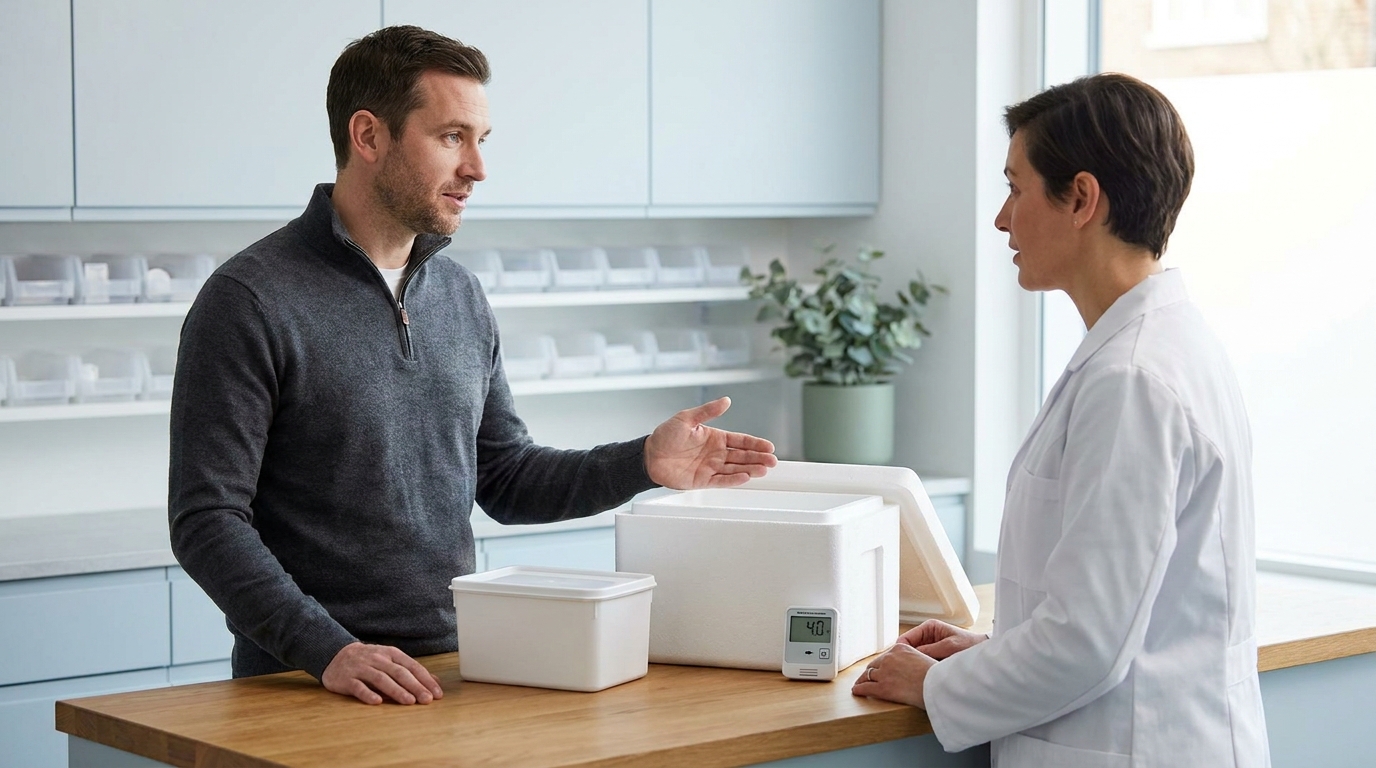
Peptide Storage and Reconstitution Basics: What to Ask Your Pharmacy
How lyophilized peptides should be stored, what happens during reconstitution, and the questions worth asking the 503A pharmacy that compounds your prescription.
Peptide vials look simple: a small glass container of white powder, sometimes a separate vial of clear liquid. But what happens to that powder before you ever draw up a dose, whether it sat in a warehouse at the right temperature, whether it was mixed with the right diluent, whether it's been refrigerated correctly since, determines whether the peptide is still doing what it was designed to do. Peptide storage and reconstitution is not a single step; it's three distinct phases, each with its own failure points.
This guide walks through what happens at each stage, what the manufacturer and handling literature says about stability, and what questions are worth asking your dispensing pharmacy directly, because the specific answers for your prescription will always matter more than any general protocol.
Table of Contents
- What Peptide Handling Actually Involves
- How Lyophilized Peptides Should Be Stored Before Reconstitution
- What Happens During Reconstitution and Why Technique Matters
- How Long Reconstituted Peptides Remain Stable Once Mixed
- Storage Conditions Before vs. After Reconstitution
- Questions to Ask Your Pharmacy About a Compounded Peptide
- Why the 503A Pharmacy Pathway Matters for Peptide Quality
- Common Handling Mistakes That Can Degrade a Peptide
- When to Contact Your Clinician Instead of Guessing
- FAQ
What Peptide Handling Actually Involves
Peptide handling covers three stages: dry storage before reconstitution, the reconstitution process itself, and storage of the reconstituted solution. Each stage carries a different risk to stability; mishandling any one of them can reduce potency before a dose is ever taken.
This article covers general handling principles for compounded peptides prescribed through a licensed clinician. It is not a substitute for the specific instructions your dispensing pharmacy provides with your prescription, and it does not recommend dosing or handling for any individual case.
What to remember: the powder in the vial, the liquid you mix it with, and the refrigerator it sits in afterward are three separate variables. Getting one right doesn't compensate for getting another wrong.
How Lyophilized Peptides Should Be Stored Before Reconstitution
Lyophilized peptides, meaning freeze-dried into a stable powder form, are generally most stable stored cold, dry, and away from light, according to handling guidance from peptide manufacturer JPT (2024). The freeze-drying process removes moisture specifically because water accelerates chemical breakdown of the peptide chain.
Bachem's handling guidelines note that heat, moisture, and repeated freeze-thaw cycles are the primary drivers of peptide degradation before reconstitution. A vial that goes from freezer to counter to freezer again multiple times is being asked to survive more thermal stress than one refrigerated consistently.
The practical takeaway is straightforward: keep unopened vials refrigerated or frozen exactly as labeled, in their original packaging, until you are ready to reconstitute. Don't move a vial to room temperature "just in case," and don't unwrap it until the day you plan to use it.
What Happens During Reconstitution and Why Technique Matters
Reconstitution means dissolving the dry peptide powder into a liquid, typically bacteriostatic water, to create an injectable or usable solution. This is the step where technique errors are most likely to occur, because it's the only phase that requires active handling rather than passive storage.
Sigma-Aldrich's peptide handling guide recommends letting vials reach room temperature before opening and using an appropriate pH buffer range to avoid degrading the peptide during dissolution. Opening a cold vial can cause condensation inside, and adding liquid to a peptide outside its stable pH range can denature the structure before it's ever used.
Common technique errors include:
- Adding liquid too quickly instead of letting it run gently down the vial wall
- Shaking the vial instead of gently swirling it, which can shear the peptide's structure
- Using the wrong diluent volume or type, altering both concentration and stability
- Handling the vial with unwashed hands or non-sterile technique, introducing contamination risk
Reconstitution volumes and diluent choice should come from your prescribing clinician and dispensing pharmacy, not general internet protocols, because concentration and intended use vary by formulation. A volume that's correct for one peptide prescription may be wrong for another entirely.
How Long Reconstituted Peptides Remain Stable Once Mixed
Stability after reconstitution varies by peptide chemistry, diluent, and storage temperature, so there is no single universal shelf-life number that applies across every compound. Anyone quoting a flat "X days" figure without naming the specific peptide and conditions is oversimplifying.
GenScript's storage guidance recommends refrigeration and protection from light immediately after reconstitution, with minimal opening of the vial once mixed. Each time a vial is opened, it's exposed to air, light, and temperature fluctuation, all of which chip away at stability over time.
Because stability windows differ by formulation, the specific expiration or beyond-use date your dispensing 503A pharmacy labels on the prescription should always take precedence over generic online timelines. That label reflects the actual diluent, concentration, and packaging used for your specific vial.
Storage Conditions Before vs. After Reconstitution
A side-by-side comparison clarifies why the two phases of storage are handled differently, and why the risks shift once a vial has been opened.
| Storage phase | Typical condition | Primary risk if mishandled |
|---|---|---|
| Before reconstitution (lyophilized) | Refrigerated or frozen, dry, dark, per JPT (2024) and Bachem guidance | Moisture exposure, heat, freeze-thaw cycling |
| During reconstitution | Room-temperature vial, appropriate diluent and pH per Sigma-Aldrich guidance | Wrong diluent, agitation, contamination |
| After reconstitution | Refrigerated, dark, minimal handling, per GenScript guidance | Light exposure, repeated temperature swings, extended time past pharmacy-labeled use window |
Always defer to the label and instructions from the pharmacy that dispensed the specific prescription. Formulations differ enough that a table like this is a framework for understanding risk, not a substitute for that label.
Questions to Ask Your Pharmacy About a Compounded Peptide
Before you reconstitute anything, a short conversation with the dispensing pharmacy or prescribing clinician can prevent most handling mistakes. Worth asking:
- What diluent and volume should I use to reconstitute this specific prescription?
- What is the labeled beyond-use date once the vial is reconstituted, and does that differ from the unopened shelf life?
- How should the reconstituted solution be stored, and does it require protection from light?
- What packaging or shipping conditions did the pharmacy use to maintain cold chain during transit?
- Who do I contact if the vial arrives visibly discolored, cloudy, or with particulate before I've used it?
These questions apply to any compounded formulation dispensed through a 503A pharmacy, regardless of which specific peptide is involved.
Why the 503A Pharmacy Pathway Matters for Peptide Quality
Prescriptions for compounded peptides are prescribed by a licensed clinician and compounded and dispensed by a 503A partner pharmacy, such as RxAve, rather than manufactured by the platform coordinating care. That distinction matters for accountability: the pharmacy handling the actual compounding and dispensing is a licensed 503A facility, separate from the clinical team writing the prescription and separate from the marketing platform connecting the two.
EliteCare, the clinical partner providing state-licensed clinicians across all 50 states for LodeRx patients, determines whether a compounded peptide is appropriate for an individual and writes the prescription that the 503A pharmacy fills. Candidacy decisions happen in that clinical relationship, not through a generic online form.
It's worth being precise about regulatory status here. Compounded formulations are not FDA-approved the way brand-name molecules are; LegitScript Healthcare Merchant Certification (effective 2026-07-30, certification 50431222) reflects healthcare merchant compliance standards, not FDA approval or a medical endorsement. Any specific compounded peptide named in patient materials should carry that same distinction: not FDA-approved for compounded formulations, which is different from the regulatory status of an approved brand-name drug.
LodeRx itself operates as a marketing brand. It does not compound, dispense, or handle protected health information; that work sits with EliteCare clinicians and the 503A pharmacy network named on your prescription label.
Common Handling Mistakes That Can Degrade a Peptide
Most stability problems trace back to a handful of repeatable errors rather than anything exotic:
- Letting a vial sit at room temperature for extended periods before or after reconstitution, rather than returning it promptly to refrigeration.
- Using tap water or an unapproved diluent instead of the specific reconstitution fluid the pharmacy provided with the prescription.
- Repeated freeze-thaw cycling of a reconstituted solution rather than a single stable refrigerated storage period for the life of the vial.
- Storing reconstituted vials in a refrigerator door shelf, where temperature fluctuates more than the interior, per NIBSC handling guidance recommending consistent cool, dark storage away from the door.
None of these mistakes are dramatic in the moment. A vial that sat out for twenty extra minutes doesn't look any different. That's exactly why following the labeled instructions matters more than trusting how a vial appears.
When to Contact Your Clinician Instead of Guessing
Some situations call for a phone call rather than a workaround. Contact your prescribing clinician or pharmacy directly if a vial looks cloudy, discolored, or contains visible particulate that wasn't there when you first received it. Reach out as well if a shipment arrived warm, delayed, or without the cold-chain packaging the pharmacy described when you filled the prescription.
Do not adjust reconstitution volume, diluent, or storage approach based on general forum or social media advice. Formulation-specific guidance from the dispensing pharmacy and prescribing clinician should govern handling decisions, not a protocol written for a different peptide, a different concentration, or a different person's prescription entirely.
If you're evaluating whether a compounded peptide is an appropriate option at all, that conversation starts with a clinician reviewing your history and goals, not with a storage guide. Learn more about how LodeRx connects patients with EliteCare clinicians to start that conversation, or review LodeRx's peptide therapy overview for general education on what compounded peptide options currently look like.
FAQ
How should I store peptides before I reconstitute them? Lyophilized (freeze-dried) peptides are generally most stable stored cold and dry, away from light and moisture, according to handling guidance from peptide manufacturer JPT (2024). Keep unopened vials in their original packaging and follow the specific refrigeration or freezer instructions your dispensing pharmacy provides, since exact conditions can vary by formulation.
How long will a reconstituted peptide last in the refrigerator? Stability after mixing depends on the specific peptide, diluent, and storage conditions, so there is no single universal number. GenScript's storage guidance recommends refrigeration, darkness, and minimal handling once reconstituted. Always follow the beyond-use date your dispensing 503A pharmacy labels on the specific prescription rather than a generic online timeline.
What supplies do I need to reconstitute a peptide? Typically a lyophilized peptide vial, an appropriate diluent such as bacteriostatic water, and clean technique for dissolving without excessive agitation. Sigma-Aldrich's handling guide recommends letting the vial reach room temperature before opening. The exact diluent and volume should come from your prescribing clinician and dispensing pharmacy, not a generic protocol.
What should I ask my pharmacy about a compounded peptide prescription? Ask about the correct diluent and reconstitution volume for that specific prescription, the beyond-use date once mixed, storage requirements including light and temperature, how cold chain was maintained during shipping, and who to contact if the vial looks unusual on arrival. These questions apply to any compounded formulation dispensed through a 503A pharmacy.
Is peptide reconstitution the same process for every peptide? No. Diluent choice, pH considerations, and stability windows differ by peptide chemistry, according to storage and handling guidance from GenScript and Bachem. That is why formulation-specific instructions from the prescribing clinician and dispensing pharmacy should always take precedence over general reconstitution guides found online.
If you're considering a compounded peptide and want to understand whether it fits your health picture, the next step is a clinical conversation, not a storage checklist. Request an intake with an EliteCare clinician to review candidacy on an individual basis.