Peptide Cold-Chain Shipping: What to Inspect When Your Order Arrives
Peptide cold-chain shipping explained: what temperature peptides need in transit, how 503A pharmacies package orders, and what to inspect on arrival.
Table of Contents
- Why Peptide Cold-Chain Handling Matters Before You Even Open the Box
- What Temperature Range Do Peptides Actually Need in Transit?
- How Peptide Cold-Chain Shipments Are Packaged for 503A Pharmacy Orders
- What to Inspect Immediately When Your Peptide Shipment Arrives
- Signs a Peptide Shipment May Have Been Compromised in Transit
- What to Do If You Suspect a Cold-Chain Failure
- How LodeRx Patients Access Peptide Therapy Through Licensed Clinicians and 503A Pharmacies
- FAQ
A box arrives on your porch, sealed, on time, exactly when the tracking number said it would. Does that mean what's inside is still good? Not necessarily. Cold-chain shipping failures for temperature-sensitive medications often leave no visible trace, which means the five minutes you spend inspecting a delivery matter as much as the prescription itself.
Why Peptide Cold-Chain Handling Matters Before You Even Open the Box
Peptides are protein-based molecules, and like most proteins, they can degrade with heat exposure, light exposure, or repeated freeze-thaw cycles. That degradation does not always announce itself. A vial can look perfectly normal, clear, unbroken seal, correct label, while the peptide inside has already lost meaningful potency.
This is a structural problem with temperature-sensitive biologics generally, not something unique to peptides. The CDC's Vaccine Storage and Handling Toolkit (2021) notes that temperature-sensitive biologics can lose potency from excursions without visible signs of damage. In other words, the absence of an obvious red flag is not the same as confirmation that a shipment is intact.
A sealed box that arrived on schedule tells you the carrier did its job. It does not tell you the contents survived the trip.
Cold-chain integrity for a compounded peptide shipment is a relay, not a single handoff. The dispensing pharmacy packages the product to survive an expected transit window. The carrier is responsible for moving it within that window. You, at the doorstep, are the final checkpoint before the product is used. If any link in that chain fails silently, you are the only person positioned to notice, which is why knowing what to look for on arrival is not optional detail, it is the last line of defense.
What Temperature Range Do Peptides Actually Need in Transit?
There is no single number that applies to every peptide formulation, but there is a widely used reference point. USP General Chapter <659> defines standard refrigerated storage as 2°C to 8°C (36°F to 46°F), and this is the range most reconstituted or liquid peptide formulations are packaged to maintain throughout shipping.
That said, manufacturer or pharmacy-specific stability data should always govern the specific product, not a general assumption. Two peptides sitting side by side in a fridge can have very different tolerances for time outside that range.
One distinction worth understanding:
| Formulation type | Typical temperature sensitivity | Shipping consideration |
|---|---|---|
| Lyophilized (freeze-dried) powder | Generally more stable at room temperature for short periods | Still shipped cold per pharmacy protocol, but less fragile in transit |
| Reconstituted liquid peptide | More sensitive to heat, light, and freeze-thaw cycling | Requires tighter cold-chain control from dispensing to delivery |
Freezing is its own hazard, and it is easy to overlook. Some liquid peptide formulations are damaged by ice crystal formation just as readily as they are by heat. "Cold" does not automatically mean "safe." A pharmacy's packaging is designed to keep a shipment inside a target band, not simply to keep it as cold as possible.
How Peptide Cold-Chain Shipments Are Packaged for 503A Pharmacy Orders
A prescription for a compounded peptide is written by a licensed clinician, then that prescription is compounded and dispensed by a 503A partner pharmacy, a distinct entity from the platform that connects patient and clinician. The FDA describes 503A compounding pharmacies as compounding a specific preparation for an individual patient based on a licensed practitioner's prescription, which is the regulatory framework these shipments operate under.
Packaging decisions are not arbitrary. USP General Chapter <1079>, Good Storage and Distribution Practices for Drug Products, outlines expectations for temperature monitoring and documentation throughout distribution, and compounding pharmacies build their cold-chain packaging protocols around that guidance.
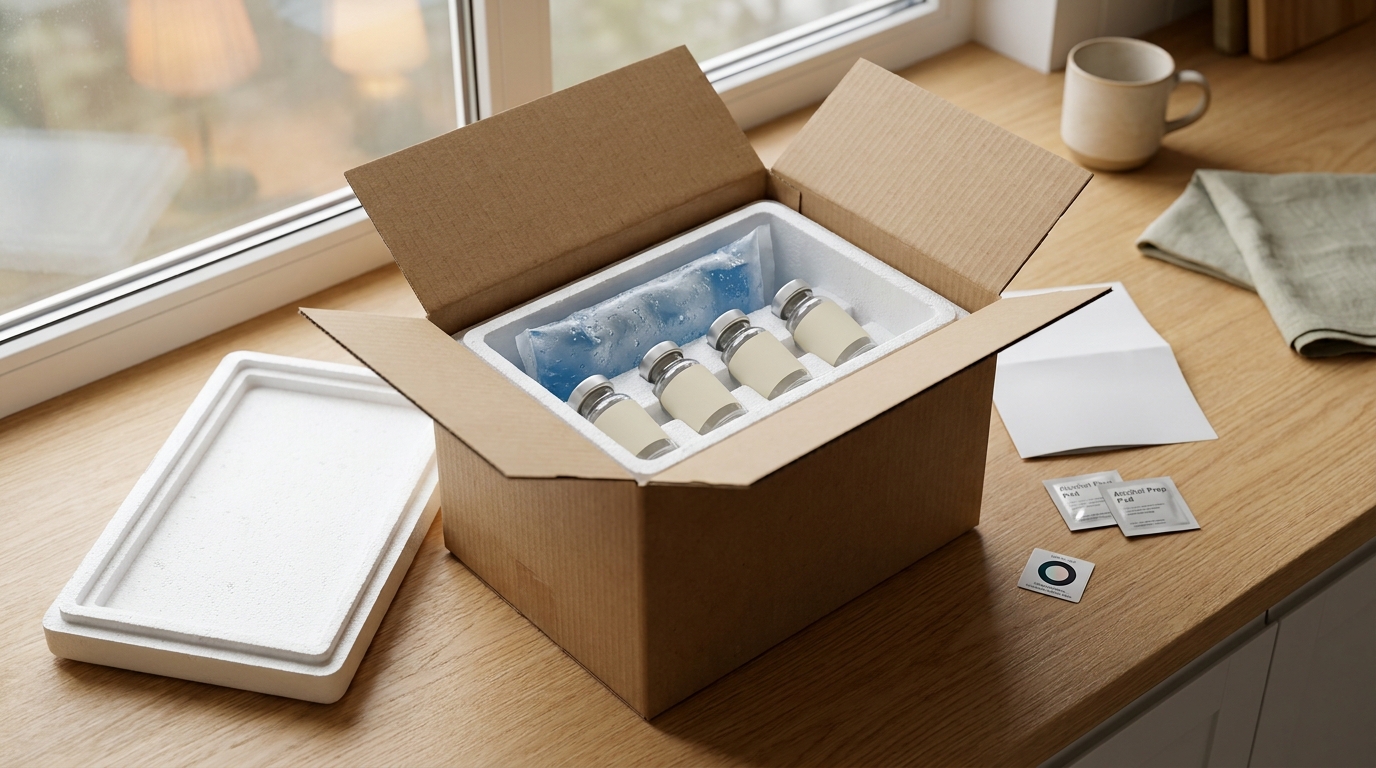
In practice, a typical cold-chain peptide shipment includes:
- An insulated liner sized to the box, not just a shipping envelope with a cold pack dropped in.
- Gel packs or phase-change material calculated for the expected transit duration, not a fixed quantity regardless of distance.
- In many cases, a passive temperature indicator or active data logger inside the box, giving a record of whether the shipment stayed in range.
- An expedited shipping method, chosen specifically to minimize the hours a shipment spends outside a controlled environment.
That last point is worth sitting with for a moment. Expedited shipping for cold-chain peptide orders is not a premium convenience; it is a stability control.
What to Inspect Immediately When Your Peptide Shipment Arrives
Open cold-chain deliveries as soon as they arrive. A box left on a porch in July or in a mailbox during a cold snap, even for a couple of hours, works against everything the packaging was designed to prevent.
When you do open it, work through a short checklist before you touch the vial itself:
- Check the outer box for a temperature indicator or data logger and record the reading before removing the contents.
- Feel the gel packs. They should still be cold, or only partially thawed depending on how long transit took. Fully warm, fully liquid packs are a warning sign, not a neutral observation.
- Confirm vial seals are intact and the label matches your prescription exactly, including strength and formulation.
- Look for visible cloudiness, discoloration, or particulate matter in liquid formulations that should be clear.
- Verify the pharmacy name and lot information on the label against the paperwork included in the shipment.
None of these steps take more than a couple of minutes, and doing them before storing the product gives you the best chance of catching a problem while it is still actionable.
Signs a Peptide Shipment May Have Been Compromised in Transit
Some signs are obvious once you know to look for them. Others require comparing this shipment to a prior one.
Watch for:
- A shipment that sat in extreme heat or freezing conditions for an extended period, particularly if a carrier delay pushed it past the expected delivery window.
- Gel packs that arrived fully liquid and warm, or, on the opposite end, ice packs that arrived frozen solid for a formulation that should never freeze.
- A vial that looks visibly different from a previous shipment of the same product: a color shift, cloudiness, or visible particles where there were none before.
- A broken, missing, or already-triggered temperature indicator seal on the box, which removes your ability to verify what happened during transit at all.
If you cannot confirm the shipment stayed in range, treat that uncertainty as information, not as something to resolve by guessing.
What to Do If You Suspect a Cold-Chain Failure
If any of the signs above apply to your shipment, the right move is patience, not improvisation.
- Do not administer or reconstitute the peptide if you have reason to believe it experienced a significant temperature excursion.
- Photograph the box, the packing materials, and any temperature indicator reading before you dispose of anything. This documentation is what allows a pharmacy to actually investigate rather than guess after the fact.
- Contact your prescribing clinician and the dispensing pharmacy directly. They are the parties positioned to evaluate a stability concern and determine whether guidance, a hold, or a replacement is appropriate.
- Keep the original shipping label and lot number. Pharmacies use this information to trace a shipment back through the distribution chain and identify whether an issue was isolated or systemic.
This is a case where erring toward caution costs you a short delay, and erring toward assumption costs you the reliability of the product you were prescribed.
How LodeRx Patients Access Peptide Therapy Through Licensed Clinicians and 503A Pharmacies
LodeRx is a marketing brand. It does not practice medicine, does not dispense medication, and does not handle protected health information. Clinical evaluation and prescribing for LodeRx patients is handled by EliteCare, whose clinicians are state-licensed across all 50 states.
Prescriptions are compounded and dispensed by RxAve and other 503A partner pharmacies, which are also the parties responsible for the cold-chain packaging protocols described earlier in this article, from insulated liner selection to expedited shipping windows. LodeRx does not compound, manufacture, or handle these products at any stage.
It is worth restating plainly: compounded peptides are not FDA-approved drug products. FDA approval applies to specific brand-name molecules; compounded formulations operate under a different regulatory framework and should never be described as the same as, equivalent to, or identical to an approved drug product. LodeRx is LegitScript Healthcare Merchant Certified, which is a healthcare merchant compliance and accreditation certification, not FDA approval and not a medical endorsement.
If you are considering starting, or restarting, a course of peptide therapy, the right first step is a conversation with a licensed clinician about your specific situation, not a general framework applied uniformly. You can review candidacy and current peptide protocols with a licensed clinician before moving forward. For background on how compounded medications differ from FDA-approved brand products, see our explainer on compounded medication basics. For more on how LodeRx's certification fits into that picture, see our overview of what LegitScript certification does and does not mean.
FAQ
What happens if peptides get warm during shipping? Peptides are protein-based and can degrade with heat exposure, potentially losing potency without any visible change to the product. Degradation depends on the specific peptide, the temperature reached, and how long the exposure lasted. If you suspect a shipment experienced significant warming, contact your prescribing clinician or dispensing pharmacy before using it rather than guessing.
How long can a peptide shipment stay unrefrigerated before it's a concern? There is no single universal answer; tolerance varies by formulation, and manufacturer or pharmacy stability data should govern the specific product. As a general reference, USP General Chapter <659> defines standard refrigerated storage as 2°C to 8°C, and shipments are packaged to stay within that range for the expected transit window, not indefinitely.
Do all peptides require cold-chain shipping? Not always. Lyophilized (freeze-dried) peptide powders are generally more temperature-stable than reconstituted liquid formulations, though this varies by product. Your dispensing pharmacy determines the appropriate packaging and shipping method based on the specific formulation and its documented stability profile.
What should I check before signing for a peptide delivery? Inspect the outer box for an intact temperature indicator, check whether gel packs are still cold, confirm vial seals are unbroken, and verify the label matches your prescription. Open the shipment promptly rather than leaving it outside, and photograph anything that looks off before contacting your clinician or pharmacy.
Are compounded peptides FDA-approved? No. FDA approval applies to specific brand-name drug molecules, not to compounded formulations. Compounded peptides prescribed by a licensed clinician are compounded and dispensed by a 503A partner pharmacy under a different regulatory framework, and should never be described as approved, equivalent to, or identical to an approved drug product.
Compounded peptides are not FDA-approved for compounded formulations. LodeRx is LegitScript Healthcare Merchant Certified, a healthcare merchant compliance and accreditation certification, not a medical endorsement. This article is general education, not individualized medical advice; discuss any specific peptide protocol with a licensed clinician.