Grip Strength as a Longevity Metric: Why Clinicians Ask and How It's Measured
Grip strength predicts mortality risk better than many vital signs. Learn why clinicians measure it, how testing works, and what your score may mean.
Can you actually feel your own mortality risk in a handshake? Researchers increasingly think the answer is closer to yes than most people expect, and the tool they use to measure it costs less than a gym membership.
Grip strength is emerging as one of the simplest, best-studied functional biomarkers in longevity medicine. It is quick to measure, requires no lab draw, and correlates with outcomes that matter: muscle mass, frailty risk, and, in multiple population studies, all-cause mortality. This guide walks through what grip strength actually measures, how clinicians test it, what the numbers mean, and where it fits alongside the bloodwork and other markers a longevity-focused evaluation typically includes.
In This Article
- What Grip Strength Measures Beyond Hand Function
- Why Researchers Link Grip Strength to All-Cause Mortality
- How Clinicians Measure Grip Strength With a Dynamometer
- Grip Strength Norms by Age and Sex
- What a Below-Average Grip Strength Score May Signal
- Grip Strength Compared to Other Longevity Biomarkers
- How to Support Grip Strength and Muscle Health Over Time
- When to Bring Grip Strength Into a Clinical Conversation
- FAQ
What Grip Strength Measures Beyond Hand Function
The squeeze itself is almost beside the point. Grip strength reflects total-body skeletal muscle mass and neuromuscular function, not just the muscles in the hand or forearm doing the work.
Clinicians use it as a proxy for overall physical capability because hand and forearm muscle output correlates with strength in larger muscle groups throughout the body. A weak or strong grip tends to track with what is happening in the legs, back, and core, which is part of why a single handshake-style test can say something meaningful about a person's broader muscular condition.
A 2024 review published in PMC by Vaishya and colleagues describes hand grip strength as an emerging "vital sign," proposed to sit alongside blood pressure and heart rate as a routine, low-cost check on overall physical status. That framing is notable: it puts a strength measurement in the same conversation as the vitals every patient already expects at a checkup.
Why Researchers Link Grip Strength to All-Cause Mortality
Grip strength research did not start as a longevity story; it started as a way to quantify frailty in older adults. Over time, the data accumulated into something broader.
Bohannon's 2019 review in PMC calls grip strength an "indispensable biomarker" for explaining a person's current health status and predicting future physical decline in older adults. Multiple population studies since have independently associated lower grip strength with higher rates of cardiovascular disease, frailty, and earlier mortality, even after adjusting for other known risk factors.
Grip strength doesn't diagnose disease on its own. It's a functional signal that prompts a closer look at overall muscle health and metabolic status, not a stand-alone verdict on someone's health.
UCLA Health (2023) notes that grip strength is already used clinically as an indicator of vitality and a predictor of physical and cognitive decline in older adults, reinforcing that this is not a fringe metric. It has moved from research curiosity to a measurement clinicians actually track.
How Clinicians Measure Grip Strength With a Dynamometer
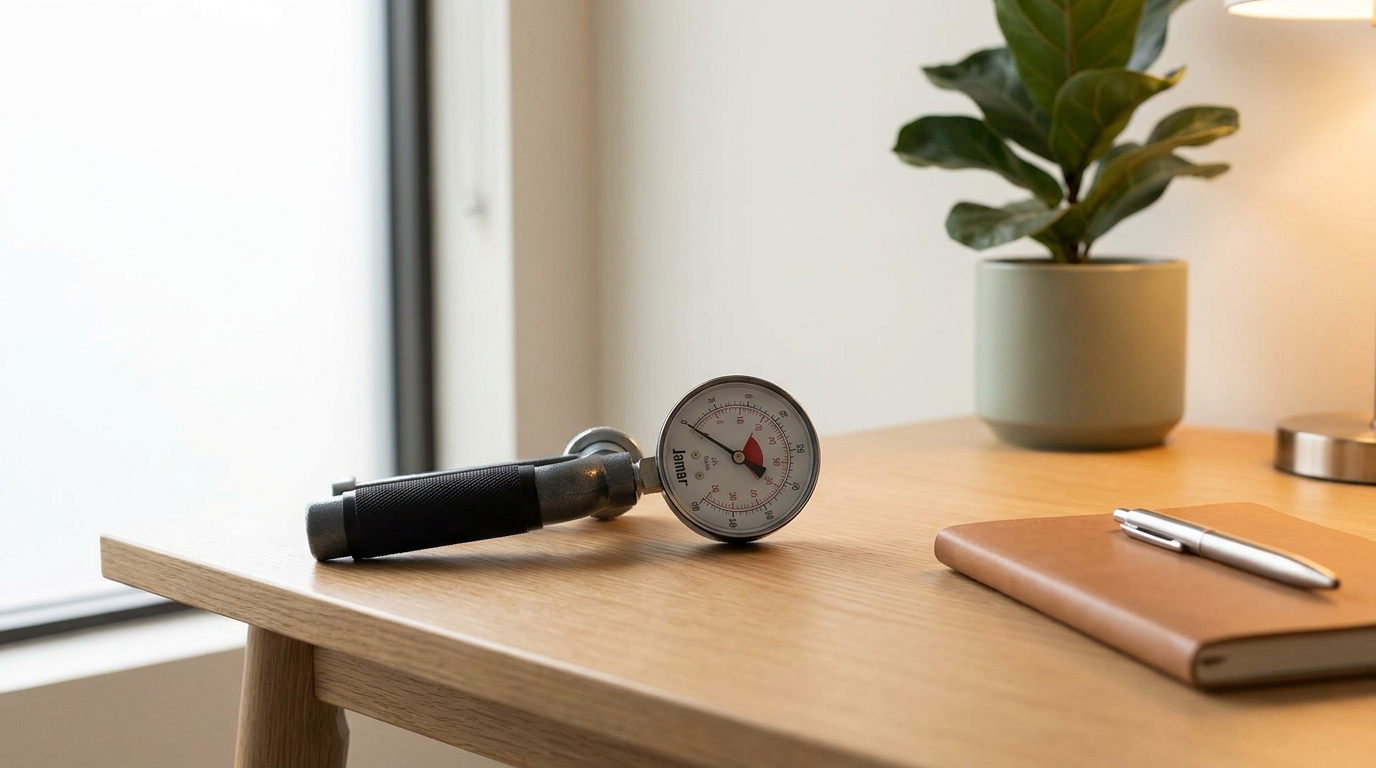
A handheld dynamometer is the standard tool for a clinical-grade reading. The patient sits with the elbow bent at roughly 90 degrees and squeezes the device with maximum voluntary effort.
Standardized protocols call for:
- Seating the patient with consistent posture, elbow at 90 degrees, wrist neutral.
- Recording multiple trials per hand, typically two to three squeezes per side.
- Alternating hands between trials to reduce fatigue bias.
- Recording the highest single reading per hand, rather than averaging across trials.
Protocol consistency matters more than people assume. A 2022 systematic review in ScienceDirect by Núñez-Cortés and colleagues found that measurement protocols vary considerably across studies of handgrip strength and all-cause mortality, which affects how any individual score should be compared to published norms.
Home or gym-based measurements using consumer grip devices are far less standardized. They can be a useful rough check over time, but a single reading from an uncalibrated device should be interpreted cautiously rather than compared directly to clinical reference ranges.
Grip Strength Norms by Age and Sex
There is no single "good" number that applies to everyone, and readers looking for one universal benchmark will be disappointed for good reason.
Average grip strength declines gradually starting in a person's 30s and more steeply after age 60, a pattern consistent across the population studies referenced in the PMC literature on grip strength and aging. Norms differ meaningfully by sex, age, hand dominance, and body size, which is why researchers compare individuals to age- and sex-matched reference groups rather than a flat population average.
| Comparison basis | Clinical usefulness |
|---|---|
| General population average | Low; ignores age, sex, body size |
| Age- and sex-matched norms | Higher; accounts for expected variation |
| Personal trend over time | Highest; flags meaningful individual change |
A single reading compared against the wrong reference group can look alarming or reassuring for the wrong reasons. That is one reason grip strength is best interpreted by a clinician who can place it in context, not read off a chart in isolation.
What a Below-Average Grip Strength Score May Signal
A lower-than-expected score is information, not a diagnosis. It can reflect reduced muscle mass, general inactivity, systemic inflammation, or early signs of frailty, depending on the broader clinical picture.
Context changes interpretation substantially. Acute illness, a recent injury, certain medications, and even short-term fatigue can all temporarily lower a grip strength reading without indicating anything chronic. A single low score taken on a bad day is not the same finding as a low score that persists or trends downward over months.
This is why grip strength functions best as a screening signal that prompts further evaluation, rather than a number a person should interpret alone and act on immediately.
Grip Strength Compared to Other Longevity Biomarkers
Grip strength earns its place in a longevity workup partly because of what it does not require: no lab draw, no imaging, no wait for results. It is inexpensive and fast to measure compared with bloodwork panels or imaging-based biomarkers, which makes it a practical first-pass functional check.
| Biomarker | Cost/Time | What It Reflects | Requires Lab |
|---|---|---|---|
| Grip strength | Low/fast | Muscle function, frailty risk | No |
| Lipid panel | Moderate | Cardiovascular risk | Yes |
| HbA1c | Moderate | Metabolic/glucose control | Yes |
| DNA methylation age | High/slow | Biological aging pace | Yes |
Grip strength complements these markers rather than replacing them. It says nothing directly about cholesterol, blood glucose, or biological aging pace measured at the cellular level. A full longevity-focused evaluation typically combines a grip strength check with a broader bloodwork panel, since muscle function and metabolic markers tell different, complementary parts of the same story.
How to Support Grip Strength and Muscle Health Over Time
The most consistently supported approach to preserving strength with age is not a grip-specific drill; it is resistance training that loads the hands, forearms, and larger muscle groups together.
- Resistance training two or more times per week, targeting major muscle groups, is the intervention most consistently linked to preserved strength with age.
- Adequate protein intake supports the muscle mass that a grip strength reading ultimately reflects.
- Consistent physical activity more broadly, not just formal strength training, supports the same underlying muscle health.
Grip strength is not something to chase in isolation. It tends to improve as a byproduct of overall strength training and activity levels, not as a standalone exercise goal. Anyone hoping to "train their grip" for longevity reasons is better served training the whole body.
When to Bring Grip Strength Into a Clinical Conversation
A noticeably weak or declining grip strength is worth raising with a clinician, particularly when it shows up alongside fatigue, unintended weight loss, or reduced tolerance for everyday activity. Those combinations point toward a broader workup rather than a hand-specific issue.
State-licensed clinicians through EliteCare can help place a grip strength finding into the context of a full evaluation, including relevant bloodwork and health history, rather than reading the number in isolation. LodeRx connects patients with these clinicians for that kind of evaluation; LodeRx itself does not provide clinical assessment or interpret individual results.
LodeRx is LegitScript Healthcare Merchant Certified. That certification is a healthcare merchant compliance and accreditation standard; it is not FDA approval and not a medical endorsement of any specific treatment.
FAQ
Why is grip strength a measure of longevity?
Grip strength correlates with total-body muscle mass and neuromuscular function, both of which decline with aging and illness. Large population studies, including a 2019 review in PMC by Bohannon, associate weaker grip strength with higher risk of frailty, cardiovascular disease, and earlier mortality, making it a useful functional screening signal.
How is grip strength measured for a longevity assessment?
Clinicians typically use a handheld dynamometer, with the patient seated and elbow bent at 90 degrees, squeezing maximally across multiple trials per hand. A 2022 review in ScienceDirect found protocols vary between studies, so results are most meaningful when compared using a consistent method and age- and sex-matched norms.
What is a normal grip strength for a 70 year old?
Normal ranges vary by sex, body size, and the specific study population used as a reference, and there is no single universal number. A clinician can compare an individual reading to published age- and sex-matched norms and consider it alongside other health markers rather than in isolation.
Can I improve my grip strength to lower mortality risk?
Resistance training and consistent physical activity support the muscle mass that underlies grip strength, and both are broadly linked to better health outcomes. Grip strength itself is a marker of underlying muscle health; there is no guaranteed outcome from training grip alone, so it is best viewed as one part of overall strength and fitness.
Is grip strength better than blood pressure at predicting health outcomes?
Some studies suggest grip strength adds predictive value for mortality risk beyond traditional vital signs, per research summarized in PMC (Vaishya et al., 2024). It is not a replacement for blood pressure, bloodwork, or other standard clinical measures, but a complementary functional indicator clinicians increasingly track.
A grip strength reading is a starting point, not a verdict. If your own score seems lower than expected, or you simply want it read in context with a fuller picture of muscle health and metabolic markers, reviewing a bloodwork panel with an EliteCare clinician through LodeRx is a reasonable next step. Pair that conversation with a look at strength training basics if building a resistance routine is new territory.