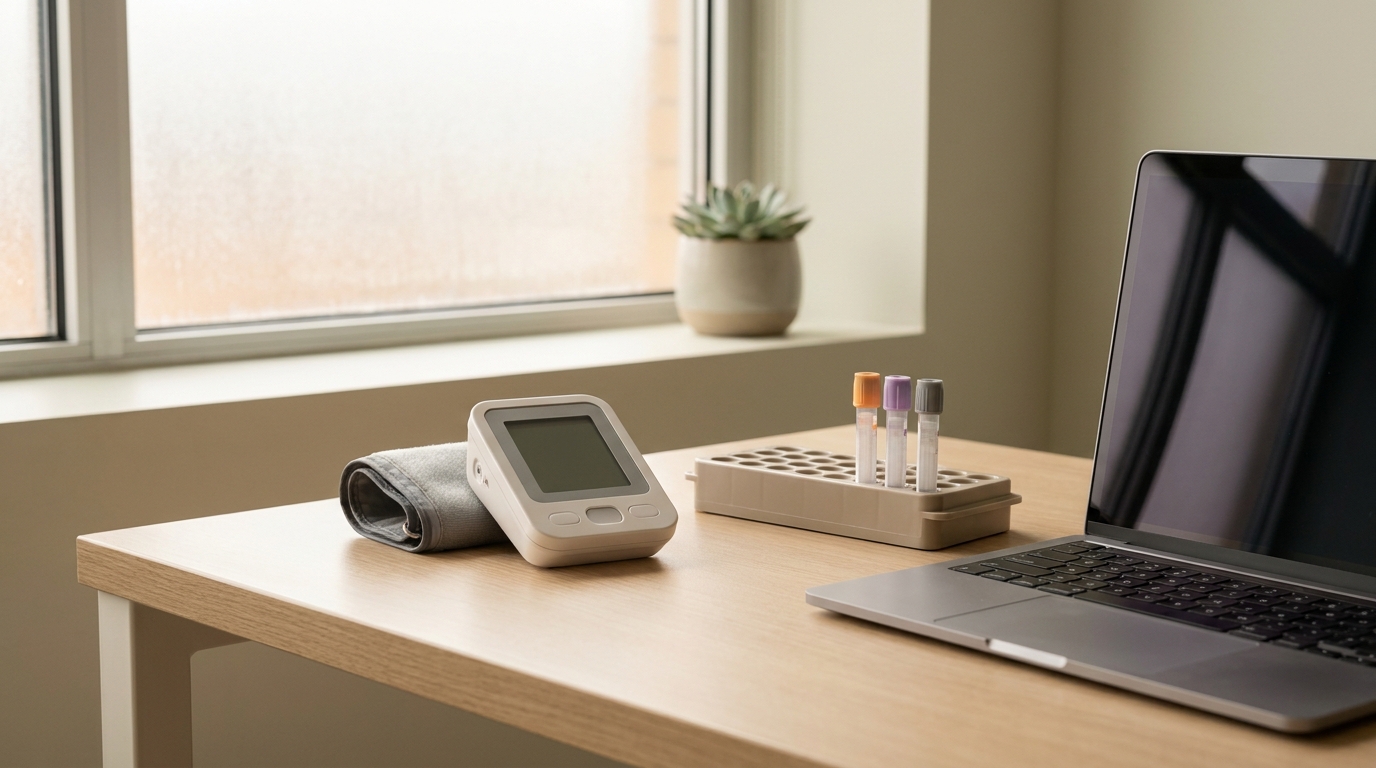
TRT and Blood Pressure: What Clinicians Monitor During Treatment
TRT can modestly raise blood pressure, mainly through increased hematocrit. Learn what clinicians check before and during testosterone therapy.
What This Article Covers
- TRT and Blood Pressure: Why Clinicians Watch This Closely
- How Testosterone Therapy Can Raise Blood Pressure
- Hematocrit and Blood Viscosity: The Main Driver of BP Changes on TRT
- Baseline Assessment Before Starting TRT
- Monitoring Schedule: What Gets Checked and When
- TRT Blood Pressure Monitoring at a Glance
- Warning Signs That Warrant a Call to Your Clinician
- What Happens If Blood Pressure Rises During TRT
- How Compounded Testosterone Fits Into This Picture
- FAQ
If your blood pressure cuff has been reading a little higher since you started testosterone therapy, you are not imagining it, and you are also not necessarily in danger. Testosterone replacement therapy (TRT) can move the needle on blood pressure in some men, and the reason has more to do with your blood than your arteries. This guide walks through what the research actually shows, what your clinician is checking for, and when a change in your numbers is worth a phone call instead of a wait-and-see approach.
TRT and Blood Pressure: Why Clinicians Watch This Closely
Testosterone replacement therapy is associated with modest blood pressure increases in some men. A 2025 report in JAMA Network covering updated FDA testosterone labeling found that testosterone products appeared to raise blood pressure in some patients without a corresponding increase in cardiovascular adverse events (jamanetwork.com). That distinction matters: a measurable change in a number is not the same thing as a measurable change in risk, but it is still a number worth tracking.
Cardiovascular monitoring, including blood pressure and hematocrit, is a standard part of clinical oversight during testosterone therapy. It is not an optional add-on that a clinician tacks on for cautious patients; it is baked into how responsible TRT care is structured from day one.
This article is general education, not individualized medical advice. A licensed clinician determines what monitoring makes sense for a specific patient based on personal history, current labs, and how the body responds over time.
How Testosterone Therapy Can Raise Blood Pressure
A 2025 narrative review published in PMC (Basheer et al.) identifies hypertension and erythrocytosis, an elevated red blood cell count, as recognized cardiovascular risks that require periodic monitoring during TRT (pmc.ncbi.nlm.nih.gov). The review frames these as known, trackable effects rather than rare surprises.
The mechanism is usually indirect. Testosterone does not typically act as a direct pressor agent in most men; instead, it stimulates red blood cell production, and rising hematocrit increases blood viscosity. Thicker blood takes more pressure to circulate, which can show up as a higher reading on the cuff.
A 2024 study using 24-hour ambulatory blood pressure monitoring on a testosterone transdermal system found measurable changes in blood pressure parameters across the full day-night cycle (sciencedirect.com). That finding is part of why a single in-office reading does not always tell the full story; blood pressure fluctuates, and a snapshot can miss a pattern.
The short version: testosterone rarely spikes blood pressure directly. It's more often the downstream effect of thicker blood that clinicians are watching for.
Hematocrit and Blood Viscosity: The Main Driver of BP Changes on TRT
Hematocrit is the percentage of red blood cells in your total blood volume. TRT commonly increases it because testosterone stimulates red blood cell production in bone marrow, a well-documented and expected physiological response, not a side effect unique to any one formulation or delivery method.
Elevated hematocrit thickens the blood. That added viscosity can elevate blood pressure and, in some cases, increase clotting risk, which is exactly why it gets tracked alongside blood pressure rather than in isolation.
Clinicians rely on hematocrit trends over time, not a single blood pressure reading, to decide whether a dose adjustment or other intervention is warranted. A one-off high reading during a stressful week means something different than a steady upward trend across three consecutive lab draws.
Baseline Assessment Before Starting TRT
The Endocrine Society's 2026 statement on testosterone replacement therapy calls for screening and monitoring both before and during treatment, given that some risks develop slowly and are easy to miss without a baseline for comparison (endocrine.org).
A baseline panel typically includes:
- Blood pressure measurement
- Hematocrit or a complete blood count
- A review of cardiovascular history and current medications
Men with uncontrolled hypertension at baseline generally need that addressed, in coordination with their prescribing clinician, before or alongside starting therapy. Starting TRT on top of unmanaged high blood pressure adds a variable that makes it harder to know which factor is driving future changes.
Monitoring Schedule: What Gets Checked and When
Monitoring on TRT generally follows a rhythm rather than a single checkpoint:
- Baseline before treatment: blood pressure, hematocrit, and a review of cardiovascular risk factors.
- Early follow-up, commonly around 3 months: repeat hematocrit and blood pressure to catch early trends before they become established patterns.
- Ongoing periodic checks: continued hematocrit and blood pressure monitoring at intervals set by the prescribing clinician, adjusted based on individual results.
The exact timing is set by the treating clinician based on how an individual's labs and readings behave, not a fixed, one-size-fits-all protocol.
TRT Blood Pressure Monitoring at a Glance
| Parameter | What it flags | Typical monitoring point |
|---|---|---|
| Blood pressure | Direct cardiovascular strain | Baseline, then at follow-up visits |
| Hematocrit | Blood viscosity, clotting risk | Baseline, ~3 months, then periodically |
| Symptoms (headache, dizziness, visual changes) | Possible acute BP elevation | Any time, patient-reported |
| Testosterone level | Confirms therapeutic dosing range | Alongside hematocrit checks |
This table is a reference point, not a substitute for the specific plan a clinician sets for an individual patient.
Warning Signs That Warrant a Call to Your Clinician
New or worsening headaches, dizziness, chest discomfort, or visual changes should prompt a call to the prescribing clinician, not a wait-and-see approach. These symptoms are not exclusive to TRT, but they are exactly the kind of signal that a monitoring relationship exists to catch early.
A home blood pressure reading that is consistently above the threshold your clinician set for you, rather than a single unusual number, is a reason to reach out promptly.
If something feels off, the safest move is a phone call, not adjusting a dose on your own.
What Happens If Blood Pressure Rises During TRT
If blood pressure trends upward during treatment, a clinician has several tools to consider, not a single fixed response:
- Dose adjustment, to reduce the degree of hematocrit and blood pressure change
- A change in therapeutic formulation, since delivery method can influence how steadily testosterone levels, and downstream effects, are maintained
- Referral for blood pressure management with a primary care provider or cardiologist, when the elevation warrants dedicated cardiovascular care
- Therapeutic phlebotomy, a scheduled blood draw used to reduce red blood cell volume when hematocrit rises significantly
LodeRx patients are prescribed by EliteCare, clinicians licensed across all 50 states, who evaluate these findings and adjust the plan of care accordingly. Because monitoring and prescribing sit with a licensed clinical team, changes to a treatment plan are made based on lab trends and reported symptoms, not guesswork. For a broader look at how ongoing lab work fits into TRT care overall, see our guide to TRT monitoring and labs.
How Compounded Testosterone Fits Into This Picture
When a compounded testosterone formulation is part of a treatment plan, it is prescribed by a licensed clinician and compounded and dispensed by a 503A partner pharmacy. LodeRx itself operates as a marketing brand only; it does not practice medicine, dispense medication, or handle protected health information.
Compounded formulations are not FDA-approved. Only certain brand-name testosterone products carry that designation, and compounded versions should never be described in marketing or educational content as the same as, equivalent to, or identical to an approved drug. This is a regulatory distinction, not a judgment about clinical usefulness, and it is one worth understanding before starting any compounded therapy.
LodeRx is LegitScript Healthcare Merchant Certified, a healthcare merchant compliance and accreditation certification. That certification is not FDA approval and not a medical endorsement; it reflects compliance and business-practice standards, and it exists alongside, not instead of, the clinical oversight described throughout this article. Learn more about how testosterone therapy candidacy and care structure work on our TRT program hub.
If you are weighing whether compounded testosterone is a fit for your situation, our overview of who typically qualifies for TRT walks through the general criteria clinicians consider before treatment starts.
FAQ
How much can testosterone raise blood pressure? Effects vary by individual and formulation. A 2025 JAMA Network report on updated FDA testosterone labeling noted modest blood pressure increases in some patients without a corresponding rise in cardiovascular events. Clinicians track your personal readings over time rather than relying on population averages to guide your care.
What labs should be monitored during testosterone therapy? Common labs include hematocrit or a complete blood count, testosterone level, and periodic blood pressure checks. A 2025 PMC review identifies hypertension and erythrocytosis as key risks requiring periodic monitoring. Your clinician may add lipid panels or other tests based on your individual health history.
What is considered a normal blood pressure while on TRT? There is no separate "TRT normal" range; standard clinical blood pressure targets still apply, and your clinician interprets your readings against your personal baseline and cardiovascular risk factors. Sustained elevations above the threshold your clinician sets warrant follow-up, not self-adjustment of dosing.
What are early signs that testosterone therapy may be affecting blood pressure? Headaches, dizziness, visual changes, or unusually elevated home blood pressure readings can be early indicators. These aren't specific to TRT alone, so a clinician evaluation is needed to determine the cause. Report new or worsening symptoms promptly rather than waiting for your next scheduled check.
Next Step
Blood pressure and hematocrit trends are individual, and the only way to know what's normal for you is to have a clinician review your actual numbers against your health history. If you're considering TRT or already on therapy and want your monitoring plan reviewed, request an intake with EliteCare through LodeRx to have a state-licensed clinician evaluate your candidacy and lab needs directly.