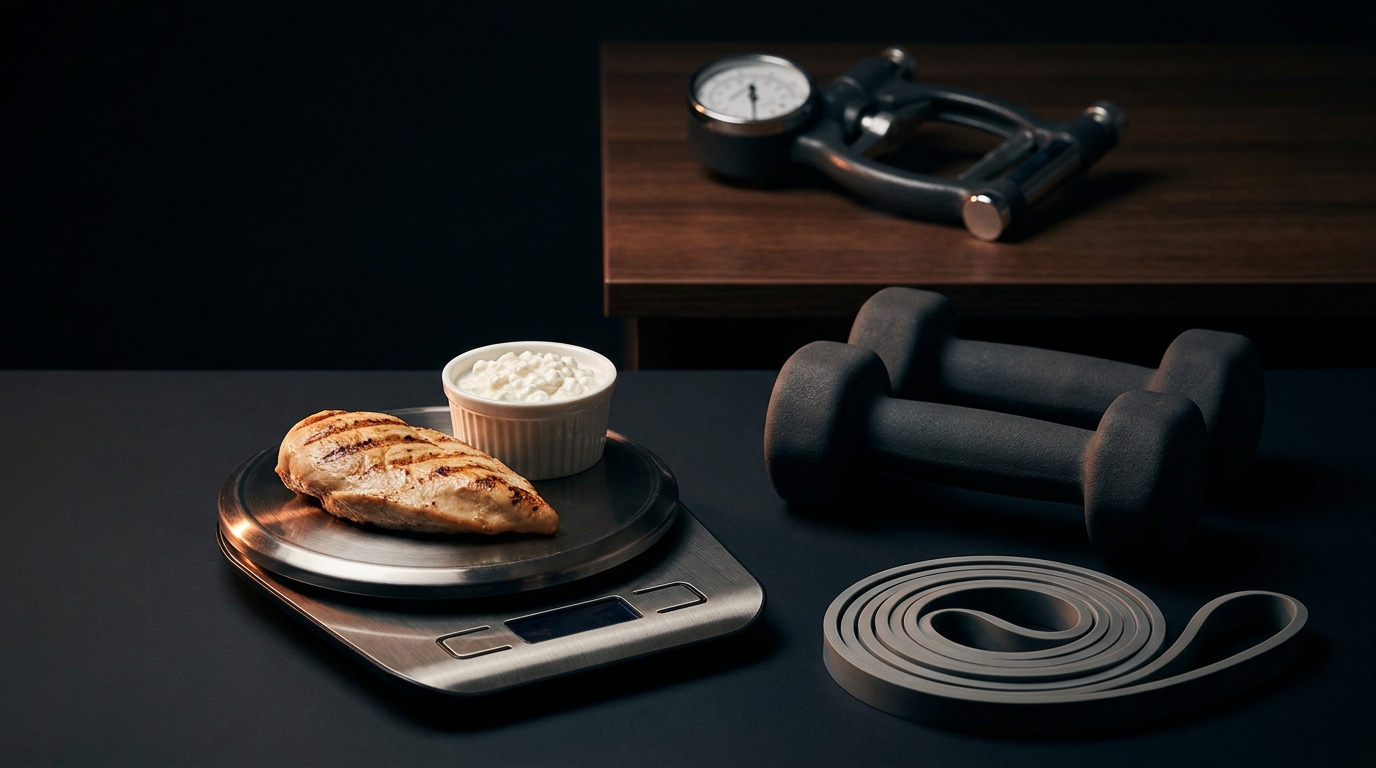
GLP-1 and Muscle Loss: What the Research Says About Preserving Lean Mass
GLP-1 medications can reduce lean mass along with fat. Here's what 2026 research shows about protecting muscle through training, protein, and monitoring.
If you've started a GLP-1 medication and noticed your weight dropping while your gym numbers slip too, you are not imagining it. Some of that scale change is muscle, not just fat, and the research on how much, and what to do about it, has moved quickly in the last two years.
This guide walks through what recent studies actually show about lean mass loss during GLP-1 therapy, why it happens, who should watch it most closely, and what the current evidence supports for protecting muscle while losing weight.
Table of Contents
- What Happens to Lean Mass When You Lose Weight on a GLP-1 Medication
- How Much of GLP-1 Weight Loss Comes From Muscle Versus Fat, According to a 2026 Study
- Why Lean Mass Loss Happens: Appetite Suppression, Caloric Deficit, and Age
- Resistance Training and Protein Intake: What the Evidence Supports
- Emerging Research: RNA Therapy and Muscle-Sparing Approaches Still in Early Stages
- Who Should Pay Closer Attention to Muscle Preservation on GLP-1 Therapy
- How LodeRx Patients Can Monitor Lean Mass and Strength During GLP-1 Treatment
- FAQ
What Happens to Lean Mass When You Lose Weight on a GLP-1 Medication
Weight loss is not a single tissue event. When the scale moves, it reflects changes in fat mass, water, glycogen, organ tissue, and skeletal muscle, collectively grouped on a body composition scan as lean mass. That grouping matters, because a drop in "lean mass" on a DEXA scan report does not mean an equivalent drop in actual muscle you can flex.
Any significant weight loss, whether driven by a GLP-1 medication, calorie restriction, or surgery, includes some reduction in lean tissue. This is a known pattern in weight-loss physiology generally, not something unique to GLP-1 receptor agonists like semaglutide or tirzepatide.
The distinction between scan-measured lean mass and functional skeletal muscle gets lost in a lot of headline coverage. A DEXA scan cannot tell you whether a patient got weaker; it only estimates composition. That is part of why researchers increasingly pair body composition scans with strength testing, a point we return to below.
For a broader look at how GLP-1 therapy is structured and monitored, see the LodeRx GLP-1 program hub.
How Much of GLP-1 Weight Loss Comes From Muscle Versus Fat, According to a 2026 Study
A 2026 study by Iorra and colleagues, indexed on pubmed.ncbi.nlm.nih.gov, found relative preservation of muscle mass during GLP-1 therapy. Reductions in lean tissue tracked generally proportional to overall weight loss, rather than showing disproportionate muscle wasting compared to fat loss.
Notably, the same study evaluated muscle strength, not only scan-measured mass. That distinction matters clinically. A person can lose some lean tissue on a scan while retaining most of their functional strength, or the reverse, and strength testing captures something a composition scan alone does not.
Findings like these vary by study population, treatment duration, and whether resistance training was built into the study protocol. A trial following sedentary older adults for a year will show a different pattern than one following younger, resistance-trained participants for twelve weeks. Readers should treat any single percentage from a headline with some caution.
Proportional lean mass loss is an expected part of any significant weight loss, GLP-1-driven or otherwise. The goal for patients and clinicians is not eliminating that loss entirely, it's minimizing the share of total weight loss that comes from muscle rather than fat.
Why Lean Mass Loss Happens: Appetite Suppression, Caloric Deficit, and Age
GLP-1 receptor agonists work in part by substantially reducing caloric intake. That reduced intake is the mechanism behind the weight loss, but it also creates the physiological conditions under which lean tissue loss is more likely: a large caloric deficit, without adequate protein or a resistance training stimulus to signal the body to retain muscle, puts lean tissue at risk alongside fat.
Older adults and people with lower baseline muscle mass may be more vulnerable to clinically meaningful declines in strength and function during this process. This is part of a broader concern that has surfaced in discussions about GLP-1 use in older populations: some patients and clinicians have raised questions about whether rapid lean mass decline is a reason certain older adults discontinue GLP-1 therapy altogether. It's one reason clinicians increasingly monitor lean mass and function rather than relying on scale weight alone.
The table below summarizes factors that appear to raise the relative risk of disproportionate muscle loss during GLP-1 treatment, based on general physiological reasoning rather than a single unified risk score.
| Risk Factor | Why It Matters |
|---|---|
| Rapid weight loss pace | Faster deficits give the body less time to adapt; more lean tissue tends to be mobilized alongside fat |
| Low dietary protein intake | Protein provides the amino acid building blocks muscle needs to be preserved during a deficit |
| Sedentary status | Without a resistance stimulus, the body has less signal to prioritize retaining muscle |
| Advanced age | Age-related muscle loss (sarcopenia risk) compounds with diet-induced lean mass loss |
| Low baseline muscle mass | Less muscle to begin with means a given percentage loss has a larger functional impact |
A short takeaway: none of these factors are disqualifying for GLP-1 therapy, but they are reasons for closer monitoring, not reasons to avoid monitoring altogether.
Resistance Training and Protein Intake: What the Evidence Supports
The general clinical consensus, reflected across recent body composition research, is that pairing GLP-1 therapy with structured resistance training and adequate dietary protein helps preserve lean mass relative to weight loss achieved through calorie restriction alone.
In practical, non-prescriptive terms, the categories that current evidence supports include:
- Resistance training performed several times per week, targeting major muscle groups
- Protein intake distributed across meals rather than concentrated in a single sitting
- Avoiding caloric restriction beyond what the medication already induces, since appetite suppression alone is often a significant deficit
This is general education, not an individualized macro or training prescription. Specific protein targets, training volume, and progression depend on a person's age, activity history, kidney function, and other individual factors that a clinician should review directly.
Muscle loss on GLP-1 therapy is not inevitable, but it is not automatically prevented either. It responds to the same inputs that protect muscle during any weight-loss process: resistance stimulus and adequate protein.
Emerging Research: RNA Therapy and Muscle-Sparing Approaches Still in Early Stages
A September 2026 release covered by eurekalert.org described an RNA therapy that, when added to semaglutide in mice, led to greater fat and weight loss while preserving more lean mass compared with semaglutide alone.
This finding is worth flagging clearly for what it is and isn't. It is animal-model research, conducted in mice, not a human clinical finding. It is not an available treatment, and it should not be read as something patients can currently access or request. Research directions like this are worth watching as the field develops, but they belong in the "early-stage science" category rather than the "available option" category for anyone making treatment decisions today.
A short paragraph of context: most muscle-sparing GLP-1 combination approaches currently discussed in the literature remain preclinical. Patients considering GLP-1 therapy today should plan around the tools that exist now, resistance training, protein intake, and clinical monitoring, rather than waiting on therapies still years from human availability.
Who Should Pay Closer Attention to Muscle Preservation on GLP-1 Therapy
Some patient groups have more reason to track lean mass and strength closely during GLP-1 treatment:
- Older adults, who generally start with lower baseline muscle mass
- Patients with low baseline muscle mass regardless of age
- Anyone losing weight unusually fast relative to their starting point
- Patients not currently engaging in any resistance training
Function, not just mass, is the more useful thing to track. July 2025 coverage from news-medical.net reported on research suggesting that muscle loss during GLP-1 treatment may undermine some of the cardiorespiratory fitness gains that would otherwise be expected from weight loss. In other words, losing weight doesn't automatically translate into feeling stronger or more capable, if a meaningful share of that weight loss comes from muscle.
This is part of why baseline and periodic strength or function assessment, not just weight tracking, is a reasonable component of monitoring during GLP-1 therapy. A grip strength test, a sit-to-stand assessment, or a simple strength log can tell a clinician something a bathroom scale cannot.
For related bloodwork and monitoring context, see LodeRx's bloodwork resource.
How LodeRx Patients Can Monitor Lean Mass and Strength During GLP-1 Treatment
Monitoring during GLP-1 treatment generally falls into a few categories patients can discuss directly with their clinician: periodic body composition tracking, strength or function checks, and routine lab review to catch other changes that accompany significant weight loss.
GLP-1 medications made available through LodeRx are prescribed by a licensed clinician and compounded and dispensed by a 503A partner pharmacy; LodeRx itself handles marketing only and is never involved in clinical decisions, compounding, or dispensing. Clinical evaluation and candidacy decisions are handled by EliteCare, whose state-licensed clinicians evaluate patients and monitor treatment across all 50 states.
It's also worth being precise about what LodeRx's certifications mean and don't mean. LodeRx is LegitScript Healthcare Merchant Certified, a healthcare merchant compliance and accreditation certification. It is not FDA approval and not a medical endorsement of any specific treatment or outcome. Compounded GLP-1 formulations are not FDA-approved; only the original brand-name molecules carry that designation, and compounded versions should never be described as the same as, equivalent to, or identical to an FDA-approved product.
For readers interested in how body composition monitoring connects to broader healthspan goals, see LodeRx's longevity content hub. For patients whose muscle and body composition questions intersect with hormone health, LodeRx's TRT resource covers an adjacent area some patients ask about alongside GLP-1 therapy.
What to remember: muscle loss during GLP-1 treatment is a real, measurable pattern, generally proportional to overall weight loss, and it responds to the same tools, resistance training, protein, and monitoring, that protect muscle during any significant weight change. It is not a reason to avoid treatment, but it is a reason to ask your clinician how your body composition and strength will be tracked over time.
FAQ
Can you keep muscle mass while taking a GLP-1 medication?
Research summarized in a 2026 study (Iorra et al., pubmed.ncbi.nlm.nih.gov) found muscle mass reductions were generally proportional to overall weight loss rather than disproportionate. Pairing GLP-1 therapy with resistance training and adequate protein intake is the general approach supported by current evidence for minimizing lean tissue loss. Individual results vary, and a clinician should guide any specific plan.
How much of GLP-1 weight loss is muscle versus fat?
Estimates vary across studies and reporting sources, and no single confirmed figure applies to every patient. A 2026 PubMed-indexed study found reductions in muscle mass that tracked proportionally with total weight loss rather than occurring disproportionately. Because methods differ across studies, patients should ask their clinician how their own body composition is being tracked rather than relying on a single headline percentage.
Is muscle loss from GLP-1 medications reversible?
Lean mass lost during weight loss, from any method, can generally be rebuilt through resistance training and adequate protein intake once a stable, maintenance-phase plan is in place. Recovery depends on age, training history, and consistency. This is general education, not a guarantee of outcome, and individual recovery should be discussed with a clinician.
What helps burn fat while preserving muscle during GLP-1 treatment?
Current evidence points to structured resistance training combined with sufficient dietary protein as the general strategy supporting fat loss while limiting lean tissue reduction. No single food, supplement, or vitamin has been shown to prevent muscle loss on its own. A clinician can help tailor a sustainable plan alongside GLP-1 therapy.
Should older adults be more cautious about muscle loss on GLP-1 therapy?
Older adults generally start with lower baseline muscle mass and may be more sensitive to strength and function declines during significant weight loss. This is one reason some clinicians recommend closer monitoring of strength, not just scale weight, in this group. Anyone with concerns about age-related muscle loss should discuss monitoring options with their clinician before and during GLP-1 treatment.
If you're considering GLP-1 therapy and want to understand how muscle and strength would be monitored throughout treatment, the next step is a conversation with a clinician who can review your individual history and build a monitoring plan around it, not a generic protocol applied to every patient.